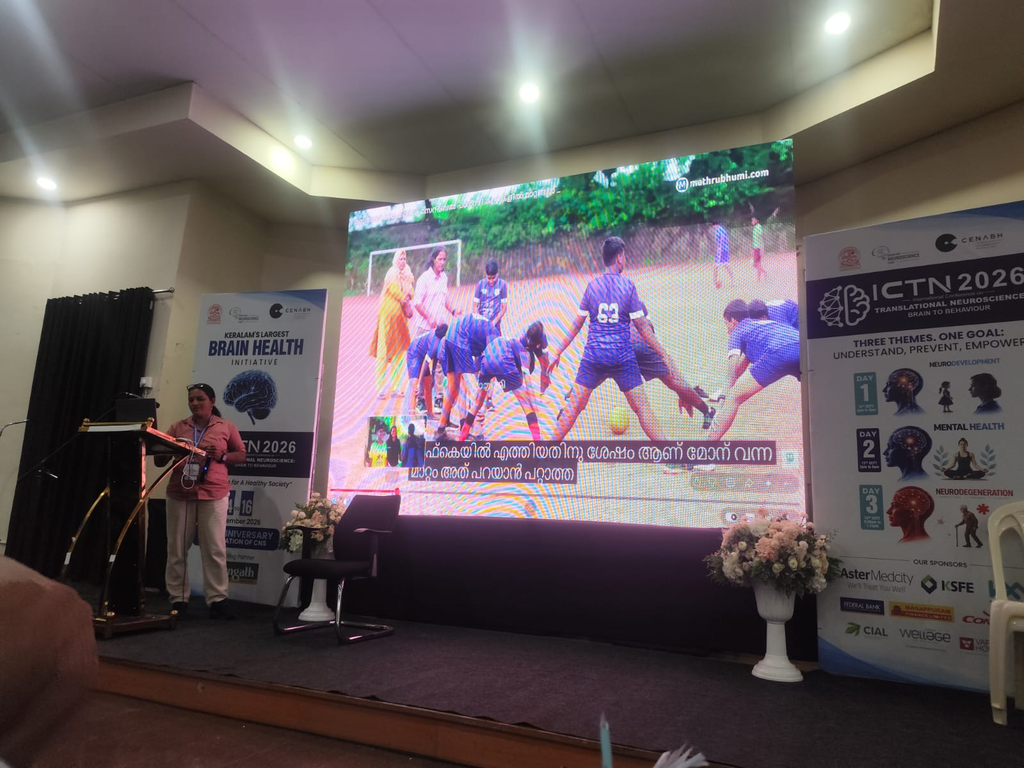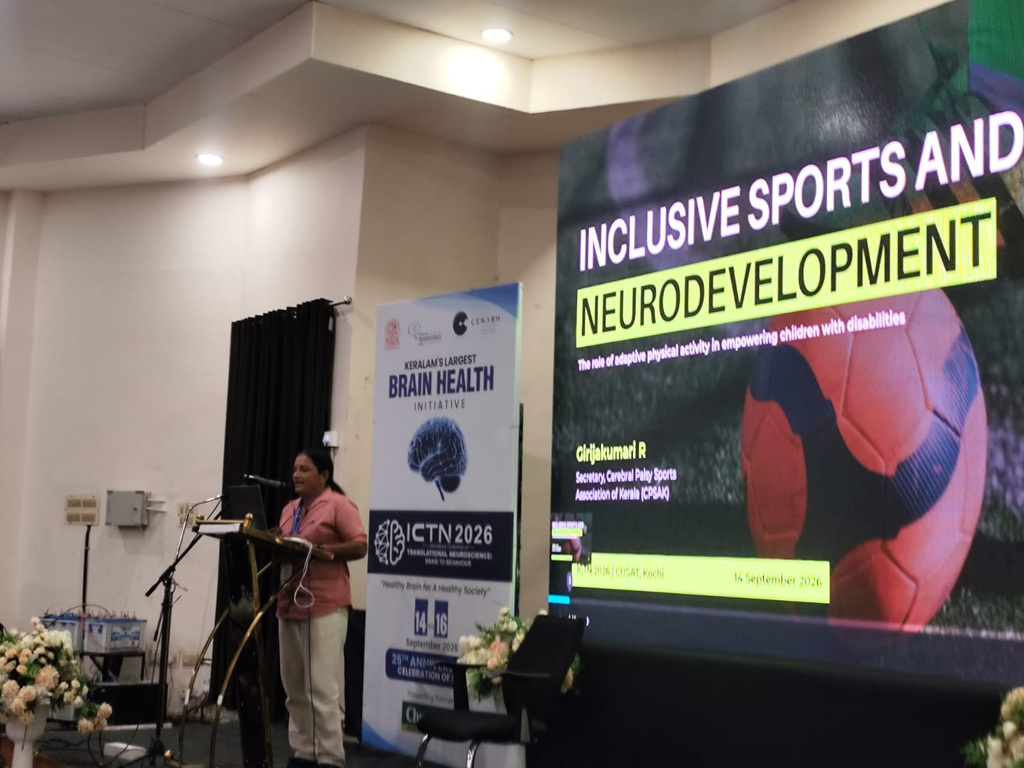
I was honoured to be invited as a speaker at the Brain Symposium, held as part of the International Conference on Translational Neuroscience: Brain to Behaviour (ICTN 2026), organised by the Centre for Neuroscience, CUSAT, Kochi.
My session, “Inclusive Sports and Neurodevelopment: The Role of Adaptive Physical Activity in Empowering Children with Disabilities,” gave me an opportunity to bring my years of practical experience in inclusive sports into a wider conversation on brain, behaviour and development.
I shared what we have learned through our work with children with disabilities — how creating the right environment for participation can support movement, motor learning, confidence, communication, social interaction and a sense of belonging.
One of the key ideas I emphasised was that participation must come before performance. Before expecting a child to perform, we need to build trust, adapt activities to the child’s abilities and help the child experience small successes.
For me, the most meaningful part of this journey is seeing how the impact of sport can extend beyond the playing field — into a child’s confidence, family relationships, social participation and everyday life.
The session also reminded me of the importance of connecting grassroots experience with scientific enquiry. Our practical observations can raise important questions for research, while research can help us understand and strengthen the work we do on the ground.
I came away with one thought that continues to guide my work:
“We do not use sport merely to create athletes; we use sport to prepare children for life.”
And sometimes, the greatest victory is not a medal, but the moment a child begins to believe:
“I can.”
Girijakumari R
Founder
Amogha Foundation